
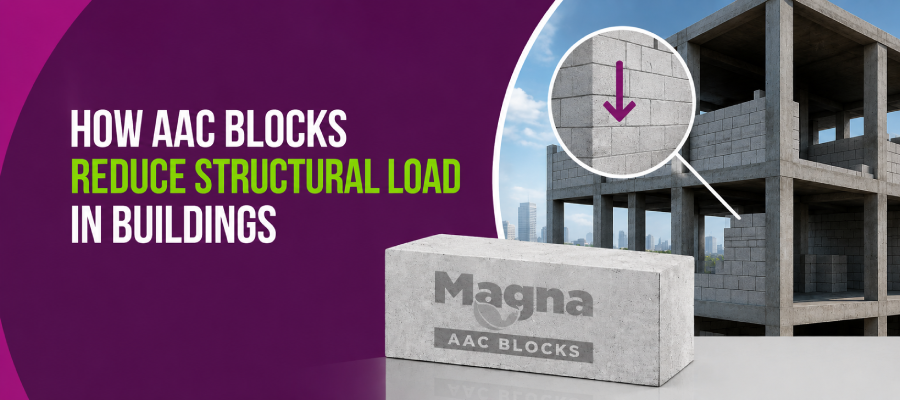
How AAC Blocks Reduce Structural Load in Buildings
 Aug 28, 2026
When we think of a building that has strength, we often think about concrete, steel, beams, and columns. But there are some more factors involved that would affect the performance of a building in terms of load-bearing capacity.
A building carries its weight upward from the base. Each component, like walls, floors, roofs, etc contributes to the total weight of the building structure from the dead load perspective. The heavier the materials used, the more capacity the structure will need to carry.
This is where AAC Blocks come into play. They are lighter than conventional clay bricks or any other traditionally used masonry material, which adds to the reduction of dead weight of the building.
What Makes AAC Blocks Lightweight?
AAC blocks are made from concrete, sand or fly ash, lime, water and a little aluminium powder. When we make AAC blocks, we treat the mixture of these things with chemicals. This creates lots of air pockets in the AAC blocks.
This air formation is what makes AAC blocks so light in weight.
Although AAC blocks look solid, their solidity is made up mainly of air. Hence, an AAC block wall will weigh less in comparison to a conventional brick wall.
The extent of decrease in weight is a function of wall thickness, density of blocks, the choice of materials, and design plan used in construction.
How Do AAC Blocks Reduce Structural Load?
The easiest way to understand the benefit is to analyze a building from its roof to its foundation.
Every wall applies load on beams, floors, and columns under it. This load is transmitted down to the soil. Therefore, if a lighter wall material is used, one can save on loads.
By swapping an ordinary heavy masonry wall for a lightweight wall made of AAC blocks, the weight carried by supports of the structure can be reduced.
This brings the following advantages:
- Smaller load on the beams and slabs
- Less weight transferred to the columns
- Lower loading on the foundation
- Possible savings in construction materials
- Easier transportation and handling
However, using AAC blocks is not enough for effective foundation reduction or reinforcement. Any structural design depends on technical calculations and site conditions.
Benefits for Multi-Storey Buildings
The benefit of the low-weight proposition becomes particularly interesting in the case of multi-storey buildings.
Consider a building with several floors. The walls on each level contribute towards the total dead load. With standard heavy masonry, this weight continues to accumulate as it is transferred to the foundations.
By employing lightweight AAC blocks, it is possible to limit the accumulated masonry load. This is especially relevant with respect to multi-storey constructions, apartment buildings, commercial buildings, etc., where minimizing the dead load can increase the efficiency of the structure.
A lighter building is less affected by seismic impacts, as seismic forces depend on the mass of the building. It does not mean that AAC blocks make a building immune to earthquakes, but lower non-structural weight may be of help if the structure is designed considering seismic requirements.
Easier Transportation and Installation
AAC blocks allow for more than just lowering the weight of the structure.
Lower weight also makes it easier for workers to move around a construction site. The block is usually easier to operate than a similar heavy masonry unit.
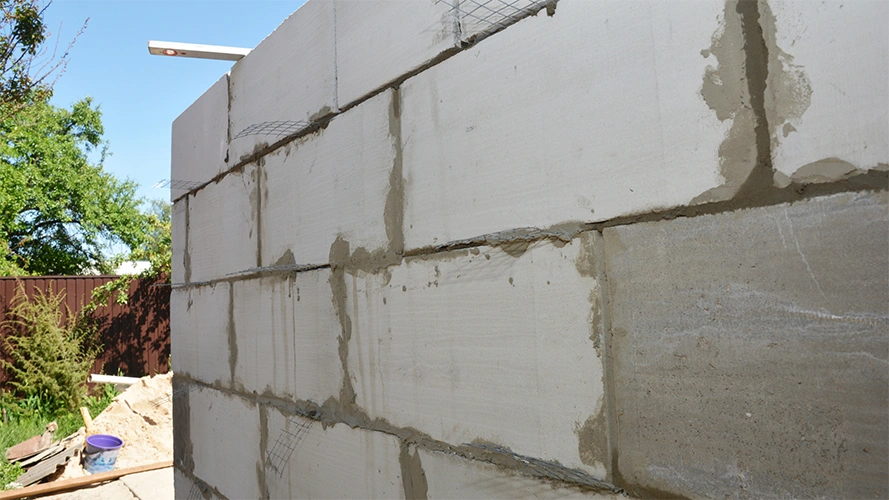
Also, AAC blocks come in larger sizes than conventional bricks, which results in fewer individual blocks necessary to construct a wall of the same area.
As a result, construction on walls can be achieved more rapidly and with nothing but a little handling.
Their dimensional precision also enables them to be applied using thin-bed adhesives when necessary, thereby reducing the amount of mortar used and ensuring uniformity on the wall surfaces.
Lower Load Does Not Mean Lower Strength
A lightweight material does not necessarily mean one that is weak.
The cellular construction and controlled manufacture of AAC blocks result in their unique properties. Because their use has been adapted to match the requirements for masonry, buildings made with blocks come in various types and densities.
In addition, AAC blocks are not supposed to serve as direct replacements for steel or concrete, as they are used as wall materials in many cases while the burden is carried by a concrete or steel frame.
Choosing the correct grade of AAC blocks, the thickness of the blocks, and the system of installation should match the requirements of the project.
What Does This Mean for the Foundation?
The walls made from AAC blocks are really light. This means the foundation of the building does not have to support much weight. So we can make the foundation better.
The weight of the building is not the thing that matters when we design the foundation. We also have to think about the soil and how much weight it can hold, the water level, how tall the building is, the weight on the columns and how much the ground will settle. We have to follow the rules for designing buildings too. AAC blocks can be useful. We have to consider all these things when we design the foundation for a building made with AAC blocks.
The right approach, however, is not to treat AAC blocks as an automatic reduction of foundation size. Rather, its reduced weight should be factored into the structural calculations from the start.
AAC Blocks and Sustainable Construction
The lightweight nature of AAC blocks would also allow for reducing the efforts in their construction.
Lower transportation weight would simplify the delivery of materials. Moreover, the production of AAC leads to the use of industrial by-products such as fly ash that increases resource efficiency, too.
The thermal insulation properties of AAC blocks are really good. This is because of the air-filled structure of the AAC blocks. It helps to stop heat from moving, and it makes the inside of the building comfortable if the outside of the building is designed correctly.
AAC blocks are good for building houses and offices because they are not very heavy and they keep the heat out.
Choosing the Right Walling Material
It is important to note that deciding on the material for masonry between AAC blocks, clay bricks and other masonry products cannot only depend on weight of the material.
There are many other considerations to be made regarding compressive strength, thermal insulation properties, water absorption properties, fire performance and wall thickness.
The person building the project the engineer and the architect need to work together to pick the material, which is AAC blocks before they start building.
Conclusion
Magna AAC Blocks offer an uncomplicated yet effective benefit to modern building practices. They minimize the building's overall weight.
In fact, these lightweight materials can result in lower dead loads on floors, beams, and the foundations as well as facilitate the construction process. In multi-story buildings, the overall decrease in weight can increase even more significantly.
The important thing about AAC blocks is that they are used not only for construction purposes, but also for the overall design of a building. As a result, the building can become lighter, more effective, and more convenient.
Recent Posts